5
min read
Zeno Power Completes Final Design Review for Space Nuclear Battery to Power Lunar Missions
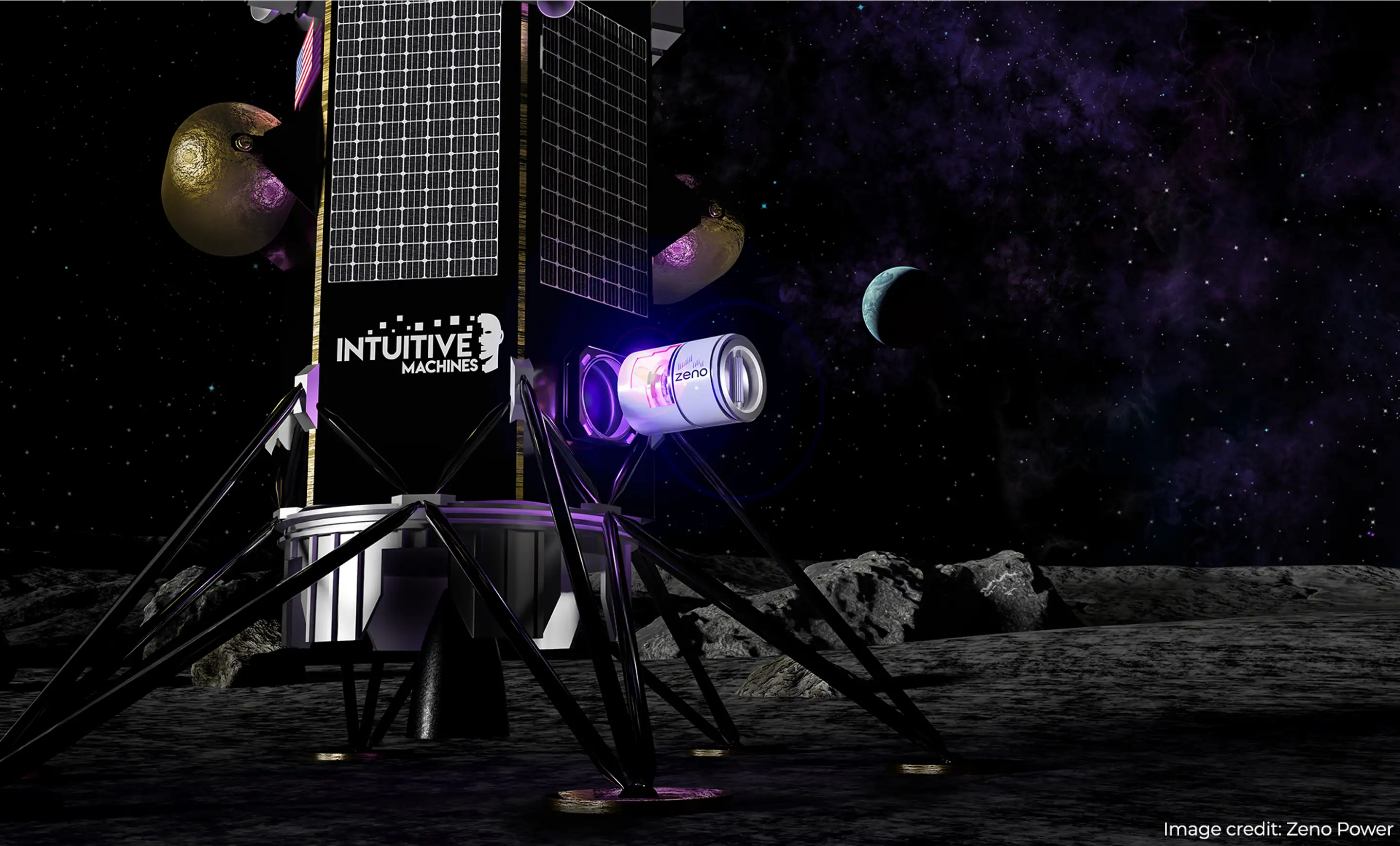
Seattle, WA – April 21, 2026 – Zeno Power today announced the successful completion of the Final Design Review (FDR) for its space nuclear battery being developed under NASA’s Harmonia Radioisotope Power System for Artemis Tipping Point program. The milestone confirms the system design meets all performance requirements, delivers 3.5 times the originally specified power output, and advances the program into build and fabrication phases. Zeno and partners will complete a terrestrial demonstration of the system in early 2027, advancing the technology toward flight qualification for lunar missions beginning in 2028.
“Completing Final Design Review for Harmonia is a critical milestone for NASA's Artemis program,” said Lindsey Boles, Chief Product Officer of Zeno Power. “Our design delivers the continuous power needed to transform lunar missions from two-week sprints into long-term operations. We're building the power infrastructure that could enable a permanent Moon Base.”
Surviving the Lunar Night is Critical for Sustained Lunar Presence
The lunar surface presents one of the most hostile environments in the solar system. During the two-week lunar night, temperatures plunge below -280°F, solar panels stop generating power, batteries drain, and electronics freeze. In 2024, NASA and industry identified the inability of spacecraft to survive and operate through the lunar night as one of the most critical capability gaps for sustained lunar exploration.
Recent U.S. commercial lunar missions have faced this challenge firsthand. In 2024 and 2025, the United States made its return to the Moon with three commercial landers. Each completed its primary mission but lacked the thermal and power systems needed to survive the lunar night, ceasing operations within two weeks.
U.S. efforts to utilize lunar resources, such as water, metals, and helium-3, will require power and long-duration operations, making night survival essential. NASA recently announced that radioisotope power systems are part of the agency’s plan for establishing a sustained lunar presence and building a Moon Base, a goal that depends on solving the lunar night power challenge.
Nuclear Batteries Deliver Continuous Lunar Surface Power
Zeno is leading the Harmonia Radioisotope Power System for Artemis team to develop an RPS to power missions through the lunar night. Supported by a 2023 NASA Tipping Point award, Harmonia is advancing an americium-241 heat source to Technology Readiness Level (TRL) 5 and Stirling Generator technology to Technology Readiness Level (TRL) 6, while delivering transition plans for flight qualification. The system will enable continuous lunar surface operations through the lunar night, providing the energy foundation for a new era of sustained exploration.
The Harmonia team brings together leading space and technology partners including NASA’s Glenn Research Center, Blue Origin, Intuitive Machines, Sunpower, and University of Dayton Research Institute.
FDR: Exceeding Expectations for Power Output
The Harmonia FDR validated the complete system design across all subsystems and confirmed readiness for hardware fabrication. NASA’s FY2027 Budget Request identifies Harmonia milestones as a key achievement planned for the upcoming fiscal year. Notably, the design demonstrates substantial margin to requirements, achieving power output that exceeds the original specification by a factor of 3.5. This margin provides flexibility for mission integration and diverse operational scenarios on the lunar surface.
Path to Demonstration and Flight Qualification
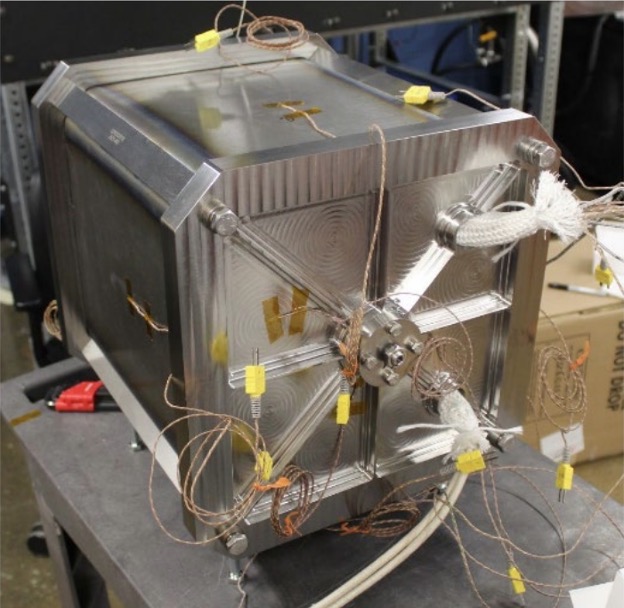
Zeno and partners are now working toward a terrestrial demonstration of an Electrically-heated Stirling Generator integrated with a Lunar Lander Simulator in early 2027. The demonstration will include electromagnetic interference testing, thermal vacuum testing to replicate lunar surface conditions, and vibration testing to simulate launch loads.
A successful demonstration will achieve TRL 6 for Zeno’s space nuclear battery which could support NASA and commercial missions in the latter part of the decade.
Beyond the initial NASA demonstration, the space nuclear battery is capable of integration with commercial lunar landers and surface systems, positioning Zeno to support the growing commercial lunar economy, enabling missions for a range of customers.
"Exceeding performance requirements at FDR confirms we have the right design to support NASA’s long-term lunar ambitions," said Tyler Bernstein, Co-Founder and CEO of Zeno Power. “Harmonia delivers the continuous power needed to unlock sustained lunar operations – a capability that could support NASA, commercial partners, and the lunar economy taking shape."
About Zeno Power
Zeno Power is the leading developer of nuclear batteries – compact power systems that provide reliable, clean energy in extreme environments. By harnessing the heat from radioisotopes, Zeno's batteries power critical missions on Earth, in space, and at sea. Zeno has secured more than $60 million in U.S. government contracts with NASA and the Department of War. The company has successfully demonstrated a scaled nuclear prototype, secured its initial nuclear supply chain, and is on track to deliver its first systems in 2027. Zeno recently closed its $50 million Series B round, and is backed by leading venture capital firms. Founded in 2018, Zeno has 75+ team members between its offices in Washington, D.C. and Seattle, WA.
Media Contact
Kelsey Bates
Communications Manager
[email protected]